
 By Robert Mutasi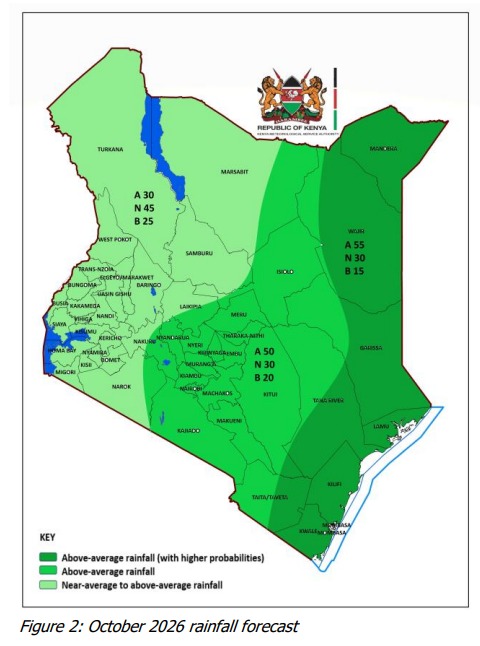
The forecast indicates that the rains are likely to continue across the Lake Victoria Basin and western parts of the Rift Valley, with Uasin Gishu listed alongside Nandi, Trans Nzoia, Elgeyo-Marakwet, West Pokot, Bungoma, Kakamega, Vihiga, Siaya, Busia, Baringo, Kericho, Bomet, Kisumu, Homa Bay, Migori, Kisii, Nyamira, Turkana and Samburu.
KMSA Acting Director Edward Muriuki said the enhanced rainfall could bring benefits to agriculture and water resources, but warned that some areas could experience weather-related hazards.
“The enhanced rainfall is likely to increase the probability of weather-related hazards such as flash floods, riverine flooding, landslides, and localized infrastructural damage,” Muriuki said in the monthly forecast.
He identified low-lying areas, flood-prone river basins, poorly drained urban centres and steep highland areas as particularly vulnerable to the effects of heavy rainfall.
For Uasin Gishu, the forecast comes as farmers prepare for the planting season and livestock keepers look to improve pasture and water availability.
KMSA said the expected rains could improve soil moisture, support land preparation and planting, and promote pasture regeneration. The rains are also expected to replenish water sources and improve availability of water for domestic, agricultural and industrial use.
However, farmers have been cautioned that excessive rainfall could also create challenges. Waterlogging may affect crops, while wet conditions could increase crop diseases and delay farm operations.
The movement of agricultural produce could also be affected where roads become muddy or damaged by prolonged rainfall.
KMSA warned that heavy rains could disrupt transport through flooding, waterlogging and erosion of roads and bridges.
“Rural access roads are particularly vulnerable to becoming impassable after sustained rainfall, while urban areas may also experience traffic disruptions when drainage systems are overwhelmed,” the forecast states.
The agency also raised concerns about possible public health risks associated with increased rainfall.
Stagnant water could provide breeding grounds for mosquitoes, potentially increasing the risk of malaria transmission in susceptible areas. Flooding and poor drainage could also increase the risk of water-borne diseases where sanitation and water quality are compromised.
The rainfall outlook shows that parts of western Kenya and the Rift Valley began receiving the rains in September, with the wet conditions expected to continue into January next year.
The coastal counties are already experiencing rainfall, with cessation expected in the second week of December.
In northeastern Kenya, including Marsabit, Mandera, Wajir, Garissa and Isiolo, rainfall is expected to begin during the first week of October and continue until the second week of December.
KMSA said rainfall in the South-Eastern lowlands and parts of the Eastern Rift Valley, including Nairobi, Kiambu, Murang’a, Nyeri, Kirinyaga, Embu, Meru, Tharaka-Nithi, Machakos, Makueni and Kajiado, is expected to begin in the second week of October and continue into January.
Residents in Uasin Gishu and other affected counties have therefore been urged to monitor weather updates and take precautions, particularly in areas prone to flooding and poor drainage.