
 By Robert Mutasi
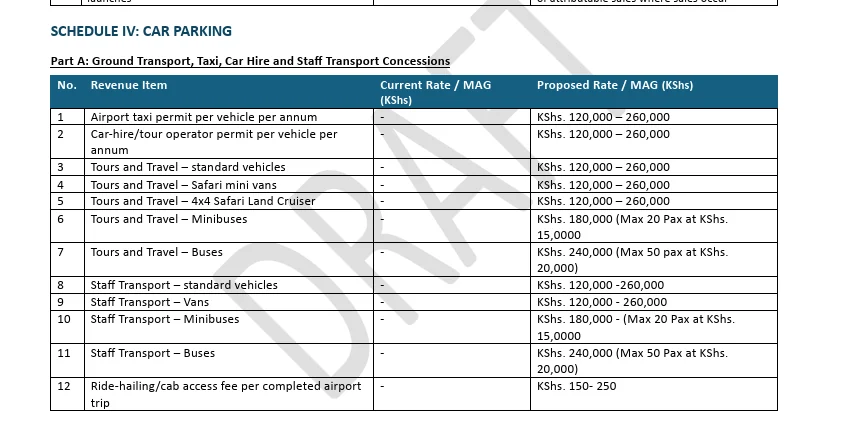
Kenyans using taxis and ride-hailing services to travel to airports could soon face additional costs following a proposal by the Kenya Airports Authority (KAA) to introduce new charges of up to KSh250 per completed trip.
The proposed charges are contained in the Kenya Airports Authority PLC Commercial Charges Order, 2026, dated November 17, which outlines a revised commercial fees structure for businesses operating at airports managed by the authority.
Follow our WHATSAPP CHANNEL for daily updates.
Under the proposed framework, Jomo Kenyatta International Airport (JKIA) would attract the highest access fee, with taxi and ride-hailing operators expected to pay between KSh150 and KSh250 for every completed airport trip.
At Moi International Airport in Mombasa, operators would pay KSh150 per completed trip, while those serving Kisumu and Eldoret international airports would be charged KSh100.
The proposed rates also include a KSh100 charge for airports classified under Band E, while operators accessing facilities under Band F would pay KSh25 per completed trip.
The KAA document categorises airports into different bands depending on their classification and commercial potential.
JKIA falls under Band A, Moi International Airport under Band B, Wilson Airport under Band C, while Kisumu and Eldoret international airports are classified under Band D.
Band E includes Malindi, Ukunda, Wajir, Isiolo, Manda, Nanyuki and Lokichogio airports, while Band F covers other airports and airstrips managed by KAA.
The authority has also proposed annual permits for airport taxi, car-hire and tour operators, with charges varying depending on the airport category.
At JKIA, annual airport taxi and car-hire operator permits would range between KSh120,000 and KSh260,000 per vehicle.
At Moi International Airport, the proposed annual taxi permit ranges between KSh120,000 and KSh200,000, while car-hire and tour operator permits would cost KSh120,000.
The proposed access fees specifically target commercial transport operators and do not amount to a general entry charge for every Kenyan visiting an airport.
Apart from the proposed ride-hailing charges, the document outlines revised parking tariffs at JKIA, including fees for motorists using the airport’s parking silo.
Under the proposed rates, motorists parking saloon cars, mini-vans and pick-ups would pay KSh150 for up to 30 minutes, up from the current KSh100.
Parking for more than 30 minutes but up to one hour would increase from KSh150 to KSh200.
Those parking between one and two hours would pay KSh400, compared to the existing KSh300, while motorists staying for between two and four hours would pay KSh500, up from KSh400.
The proposed charge for parking between four and six hours would rise to KSh750 from KSh600.
KAA has also proposed penalties for parking-related offences, including KSh1,000 for a lost parking ticket, KSh8,000 for parking in undesignated areas and KSh20,000 for tailgating.
The proposed commercial charges will not automatically become effective following the publication of the document.
Their implementation remains subject to the necessary approvals and formal communication by the authority.
Section 2.2 of the proposed order states that the framework will take effect on a date approved and formally communicated by KAA, subject to compliance with applicable legal and approval requirements.
The authority says the proposed changes are intended to establish a more structured and transparent commercial charging system across airports under its management.
According to the document, the existing concession charging framework is largely based on the 1996 Concession Order and requires revision to reflect changing market conditions, infrastructure investments, airport classifications and service quality.
KAA says the proposed framework seeks to improve consistency, transparency, commercial sustainability and revenue administration while recognising differences in passenger traffic, infrastructure and commercial opportunities across its airports.
The new charges therefore remain proposals pending the required approval process before implementation.
 Eldoret Leo