
 By Baraka Simba
The Kenya Revenue Authority (KRA) has introduced new requirements for consolidators, customs agents and importers handling consolidated cargo, in a move aimed at improving tax compliance and enabling eligible traders to claim input VAT.
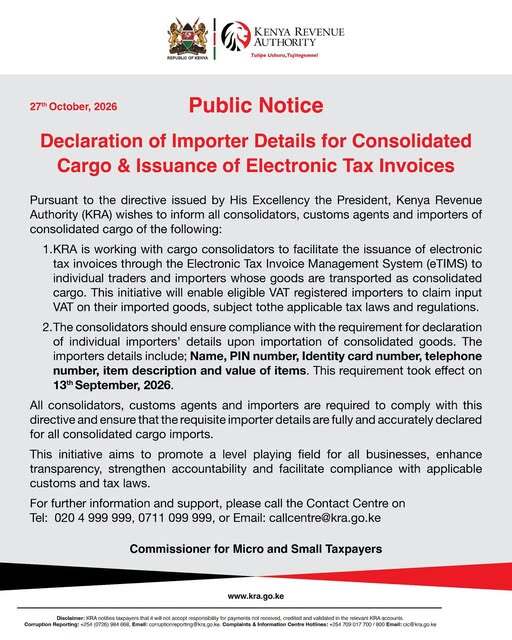
In a notice issued on Tuesday, October 27, the authority said it was working with cargo consolidators to facilitate the issuance of electronic tax invoices through the Electronic Tax Invoice Management System (eTIMS) to individual traders and importers whose goods are transported together.
“KRA is working with cargo consolidators to facilitate the issuance of electronic tax invoices through the Electronic Tax Invoice Management System (eTIMS) to individual traders and importers whose goods are transported as consolidated cargo.
“This initiative will enable eligible VAT registered importers to claim input VAT on their imported goods, subject to the applicable tax laws and regulations,” the statement read.
KRA directed consolidators to ensure that individual importers’ details are declared whenever consolidated goods are imported.
“The consolidators should ensure compliance with the requirements for declaration of individual importers’ details upon importation of consolidated goods. The importers’ details include; Name, PIN number, Identity card number, telephone number, item description and value of items. This requirement took effect on 13th September, 2026,” the statement added.
The required information includes the importer’s name, Personal Identification Number (PIN), identity card number, telephone number, description of the goods and their value.
The authority said all consolidators, customs agents and importers must ensure that the information is fully and accurately declared for every consolidated cargo shipment.
“All consolidators, customs agents and importers are required to comply with this directive and ensure that the requisite importer details are fully and accurately declared for all consolidated cargo imports,” the statement further read.
KRA said the initiative seeks to promote fair competition, enhance transparency and accountability, and strengthen compliance with customs and tax laws.
“This initiative aims to promote a level playing field for all businesses, enhance transparency, strengthen accountability and facilitate compliance with applicable customs and tax laws,” the statement concluded.
Separately, KRA has rolled out a new cargo tracking framework aimed at improving the monitoring of goods under Customs control.
In a statement issued on Tuesday, October 27, the authority announced the introduction of a Multi-Vendor User-Owned Electronic Seals Framework, which changes how electronic cargo tracking seals are supplied, owned and managed.
The new framework replaces the previous arrangement, which had been in place since 2017 and relied on a single vendor to supply and manage the devices.
“The transition follows consultations with industry stakeholders and seeks to address operational challenges associated with the existing model, including the unavailability of electronic seals at cargo tagging points and the use of ageing devices that may not function optimally,” the statement read.
Under the new arrangement, electronic seals will be owned and managed by vendors or users, depending on the commercial agreements between the parties.
Cargo owners and other users will also be allowed to select participating service providers and negotiate arrangements that suit their operational needs.
All electronic seals deployed under the framework will be integrated with the East African Community (EAC) Regional Electronic Cargo Tracking System (RECTS), enabling KRA to maintain real-time monitoring and end-to-end visibility of goods moving under Customs control.
“This technology has drastically reduced incidents of cargo diversion, smuggling, and theft, ensuring that goods reach their intended destinations securely and on time,” the statement added.
KRA said the multi-vendor model is expected to improve the availability of electronic seals, particularly at cargo tagging points, where shortages have contributed to queues and delays in processing goods.
The framework is also expected to increase competition among service providers, improve device performance and give cargo owners greater flexibility in accessing tracking services.
“Improved device performance is also expected to minimise unnecessary tracking alerts and associated enforcement interruptions, contributing to faster cargo clearance and turnaround times,” the statement concluded.
 EldoretLeo
 Eldoret Leo
 Robert Mutasi